



Invitation to optimize local anesthetic techniques in Pediatric dentistry
Why do harm… in order to do good?
Local anesthesia (A.L) is one of the great challenges in the practice of Pediatric Dentistry.
It is not only the fear of injection and acceptance of anesthesia than act as obstacles, but once accepted, even the classic method of intraoral injection with a high-pressure plunger syringe – as in intramuscular injection – is considered an abuse in Pediatric Dentistry today. Children – smarter than us adults – asked in the course of our experience – rightly: why should a single tooth numb the whole cheek? Why did I bite my lip? Why – for the treatment not to hurt – should the injection hurt first? Why does the tooth still hurt after local anesthesia? Therefore, the technique of local anesthesia in pediatric patients entails problems at different levels: acceptance of the patient, justification of the procedure, avoidance of risks, control of a painless technique, efficiency, why do harm to do good?
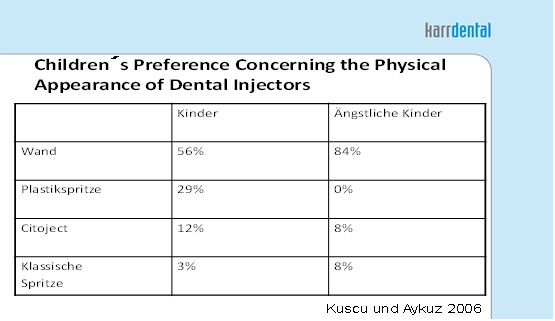
Indeed, for 160 years now – since it was invented and improved – the classic hypodermic syringe (Lafarque-1836, Jayne-1841, Wood-1843, Pravaz-1853) – local anesthesia has never been revolutionized until now and due to the AL electronically controlled technology Wand / STA, Milestone Scientific USA and / or Sleeper One, Quick Sleeper brand Dental Hi Tec / Cholet / France, Citoject etc. This equipment atraumatically injects low-pressure anesthetic and immediate high-efficiency electronically controlled installation. In addition, the concept of STA (Single Tooth Anesthesia) has radically changed the AL technique as only one or two causal teeth can be strictly anesthetized / without the discomfort of anesthesia of soft parts, an undeniable advantage for the child patient. They chose the non-anxiogenic design of the pen-electronics syringe. See tab1.
The above are sufficient arguments for dentists in 2021 to train in the use of this electronic injection equipment for the benefit of our children / adolescents but also of our adult patients.
L’anesthésie locale chez l’enfant et l’adolescent. Clinic Focus, 2015, Jean Louis Sixou
