


ECC Management during the SARS-CoV-2 Pandemic
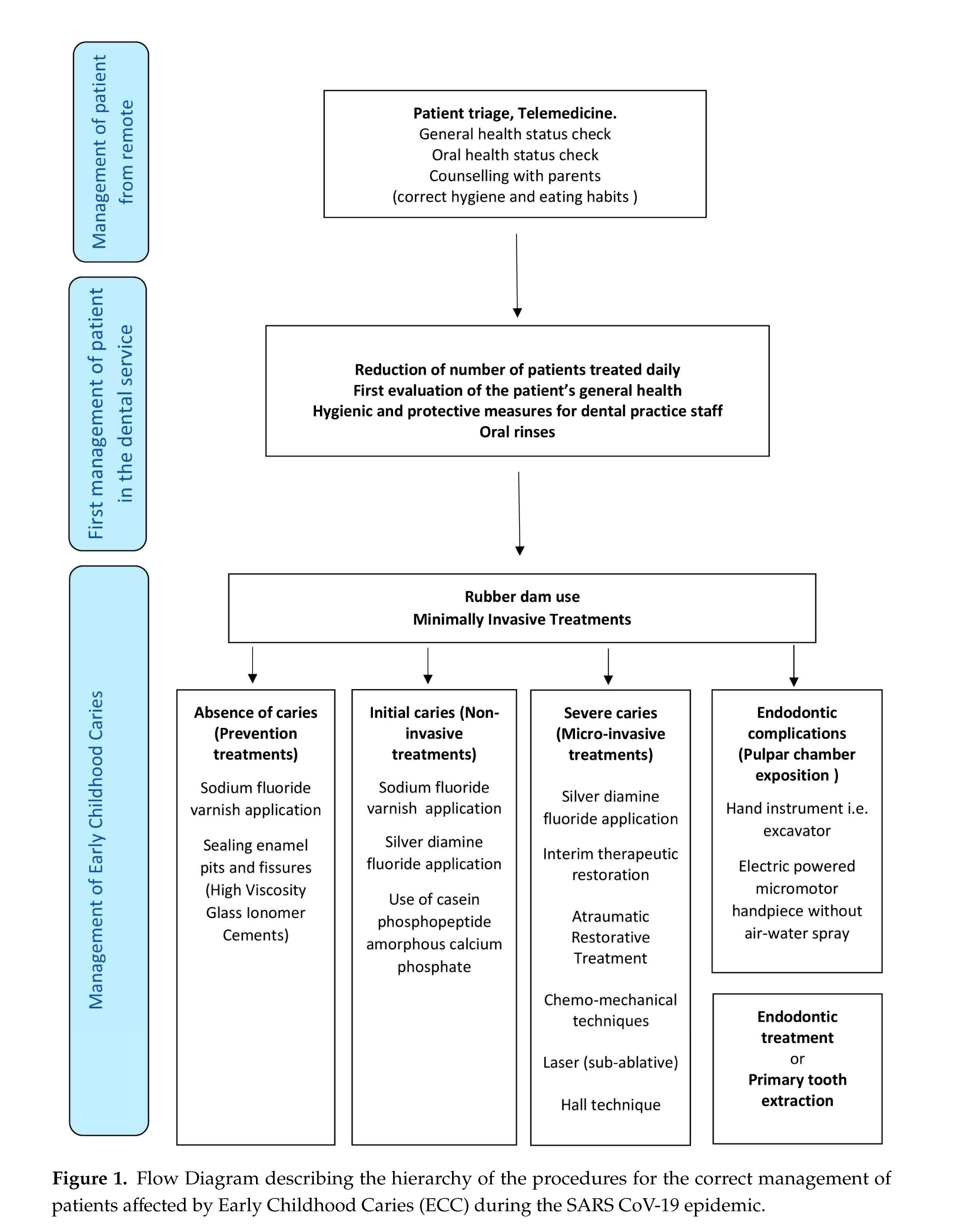
In November 2020- a second wave SARS-CoV-2 pandemic constitutes an imminent threat to society, with a potentially immense toll in terms of human lives and a devastating economic impact. In Romania but all around the world Dentistry is one of the most at-risk medical disciplines, as the oral cavity –the field of this speciality- is part of the upper respiratory tract (1,2,3 )The dental treatment of early childhood caries in a period of crisis (SARS-CoV-2 pandemic) consists of a series of interventions that must satisfy a dual purpose:
- to guarantee the maximum degree of safety by avoiding any type of infection transmitted by the saliva droplets of the patient to the health workers (and vice versa),
- and to bring the patient back to a state of oral well-being.
ECC (Early childhood caries) is a worldwide health problem. The suspension of dental health treatments during the SARS-CoV-2 pandemic could well affect ECC status in pre-school children, particularly in the socio-economically disadvantaged groups of populations where the disease has a higher degree of prevalence and severity. A new protocol for taking care of patients with ECC has been proposed based on the most current scientific evidence one capable of continuing to provide dental care to children of pre-school age in a safe, low risk of contagion from SARS-CoV-2 environment. In fact, although children affected by SARS-CoV-2 demonstrate evident symptomatology more rarely than do adults, they nonetheless can be carriers and transmitters of the viruses.
This protocol supports clinicians as a “secondary prevention” against ECC aggravation and its complications.
Prevention is always the best strategy in children’s dentistry, in terms of health gain, reduction of costs, and social inequity, particularly for the benefit of the categories of vulnerable subjects who, in times of global crisis, could increasingly be excluded from future public health policies based on the protection of the population groups with a greater chance of overcoming the state of general calamity.
The ECC Management protocol recommended in the COVID literature is based on following “general and specific safety criteria.”
- General Safety Criteria” for Avoiding SARS-CoV-2 Contamination from Saliva Droplets
- Reduction of Number of Patients Treated Daily
- First Evaluation of the Patient’s General Health
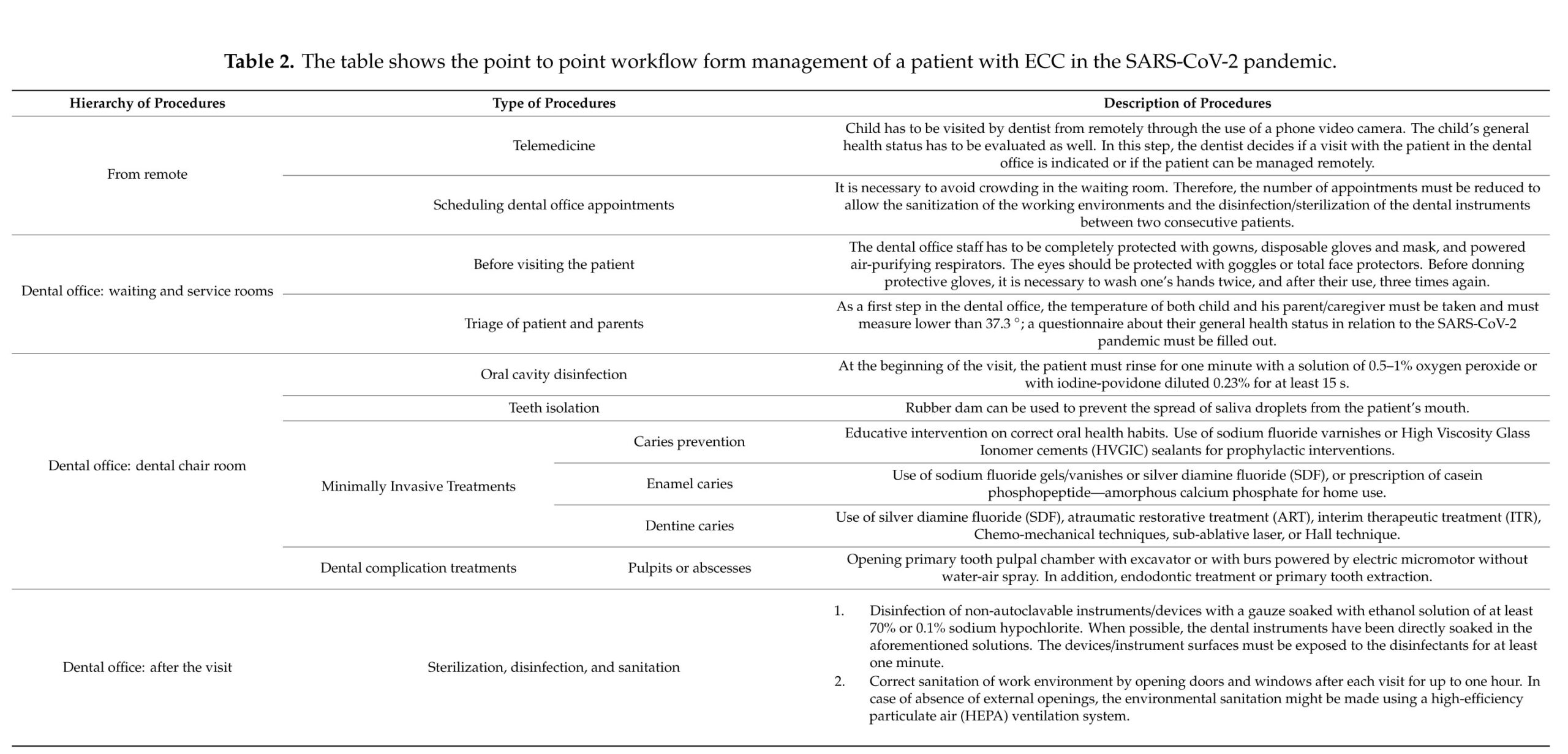
- Hygienic and Protective Measures for Dental Practice Staff. TheWest China Hospital of Stomatology- a handwashing protocol was proposed twice before and three times after dental surgery. It has been shown that over time there is a certain degree of dificulty in maintaining this habit (4,5)The office staff must absolutely wear disposable gloves, masks and gowns, respirators, goggles, and face protectors, as well as washing hands as indicated above, with each patient. The omission of even one of these criteria significantly increases the risk of contagion [6].
- Work Surface Management. Worksurface management must be reprogrammed according to the protocols included in the following two guidelines published by the National Health Commission of the People’s Republic of China:
-
- (a) Guideline for the Prevention and Control of Novel Coronavirus Pneumonia in Medical Institutes. Int. J. Environ. Res. Public Health 2020, 17, 3751 6 of 17
- (b) Guideline for the Use of Medical Protective Equipment in the Prevention and Control of Novel Coronavirus-Pneumonia.
-
- Oral Rinses. Some mouthwashes containing substances capable of reducing the infectious load of SARS-CoV-2 are indicated in the literature, such as Citrox (based on a combination of natural bioflavonoids extracted from citrus) and Amphiphilic -Cyclodextrin (a modified glucopyranoside antiviral molecule deriving from glucose). These two rinses proved effectiveness in reducing the salivary SARS-CoV-2 load due to their oxidizing action against this virus [7,8 ]. Citrox rinse showed additionally the capability of reducing the SARS-CoV-2 growth by inhibiting coronaviral chymotrypsin-like protease activity, the enzyme necessary for its replication. These two products might also be used in combination [9]. In children, however, especially those of younger age, an oral rinse is not easy to perform correctly [10]. The adoption of a gauze soaked in mouthwash to swab and disinfect oral surfaces could, therefore, be an alternative solution for younger, uncooperative children [11]. With the presence of SARS-CoV-2 infection in the upper airways, the Benzydamine hydrochloride rinse can be very useful also in clinical practice in order to reduce the phlogosis of mucous membranes in children [12].
- Rubber Dam Use. The use of the rubber dam is strongly recommended. Studies show that the dam reduces the presence of suspended particles in the work environment by 70%.
- High-Speed Drills. The use of drills (both turbine or electric-powered micro-motor handpieces) that generate sprays of water and air should be avoided (unless strictly necessary) during the pandemic period due to the risk of contamination [13], while the use of hand-instruments (e.g., excavator) is preferred. However, the use of high-rotation speed drills could be necessary in case of endodontic urgency related to deciduous dental elements where it is not possible to complete the opening of the pulp chamber by using hand-instruments. In this case, we recommend the use of high-rotation speed electrically powered micro-motors without using the spray of water and air (https://www.aegisdentalnetwork.com/id/special-issues/2014/10/power-to-the-handpiece). Similar to traditional techniques, even the most innovative ones in caries removal such as laser (used at ablative energies) or sonic and ultrasonic instruments—both using handpieces with air and water spray—are not recommended because they are possible vehicles of infection transmission.
“Specific Safety Criteria” for Avoiding SARS-CoV-2 Contamination From the Use of Air-Water Sprays Minimally Invasive Treatments (MITs)
MITs are a wide range of caries treatment interventions that aim at the maximum conservation of the tissues and the least psychological impact on the patient. The use of minimally invasive interventions has multiple positive characteristics in the management of caries during the SARS-CoV-2 pandemic. The minimally invasive interventions, in fact, are rapid in their execution (reducing the exposure times of health care workers), and have a high ability to stop caries and remineralize dental tissues while avoiding the most serious complications (e.g., pulpitis, abscesses). Some of the minimally invasive techniques allow the reconstruction of the anatomy of the tooth if are affected by cavitated lesions. The minimally invasive techniques also have the essential advantage of avoiding the use of dental drills (high-speed turbines and electrically powered micro-motors), which produce sprays of water and nebulized air, and which constitute a primary source of virus spread in the operating environment [13].
Classification of Minimally Invasive Treatments (MITs)
We will only talk about a few MITs (those that seem more suitable to the present topic), listing them according to their degree of invasiveness. In this sense, “non-invasive” treatments are defined as those that do not involve any removal of the decayed dental tissue; on the other hand, “micro-invasive” treatments are those that involve the removal (partial or total) of the softened tissues through a hand instrument (excavator). We also believe that there should be no rigid hierarchy in the choice of which minimally invasive intervention to adopt or adopt first, leaving that choice to the clinician based on the individual case.
Non-Invasive Treatments
Use of Fluoride Varnishes. The most commonly used type is 5% sodium fluoride varnish (22,600 ppm fluoride). This is employed as a primary prevention tool but also as an intervention to stop early enamel caries. Varnishes, used as prophylactic tools, reduce the incidence of caries in children and adolescents with a prevention fraction of 43% in permanent teeth (95% CI: 30% to 57%, p < 0.0001) and 37% in deciduous teeth (95% CI: 24% to 51%; p < 0.0001). The same varnishes are also elective in stopping enamel caries with a degree of remineralization of 63.6% (95% CI: 36.0% to 91.2%, p < 0.001) relating to both permanent and deciduous teeth in children. They are more elective when applied once every 6 months rather than annually.
Use of Silver Diamine Fluoride (SDF). These are commonly used at a concentration of 38% (44,800 ppm fluoride).
Use of Casein Phosphopeptide. Amorphous Calcium Phosphate (CPP-ACP) Products. These are milk protein derivatives capable of carrying high concentration calcium and phosphate ions, which, depositing on the hard tissues of the tooth, favour their remineralization. CPP-ACP is commonly available as a paste and can be administered to children directly by their parents, once a day, by spreading the product on the teeth with a toothbrush or finger.
Use of High Viscosity Glass Ionomer Cements (HVGIC) in the Prevention of Carious Lesions
Micro-Invasive Treatments
Interim Therapeutic Restoration (ITR). This is a technique that requires only slight removal of decayed dentine around the edges of the cavity of the carious lesion, leaving most of it intact. The cavity is then directly filled by HVGIC with high fluoride release. The aim is to stop the progression of caries and remineralize the dental tissues.
Atraumatic Restorative Treatment (ART) This technique involves the removal of the carious dentine with a hand instrument (excavator) and the subsequent filling of the cavity with materials with slow fluoride release (HVGIC or resin-modified glass ionomer cement (RMGIC).
Chemo-Mechanical Techniques. In this type of approach, the carious dentine is first chemically softened and then removed with hand instruments. Based on the chemical substance used, these techniques are divided into two categories: those based on sodium hypochlorite (Cariosolv) and those based on collagen-lithic enzymes (Papacarie).
Use of Sub-Ablative Energy Lasers. The most recent literature offers indications on the usefulness of some types of lasers (without a spray of air and water such as the diode laser) in reducing the bacterial load in the bottom of deep cavities where softened dentin is left .
Use of Preformed Crown (Hall Technique). This technique consists of the application of a pre-formed stainless steel crown (there are multiple sizes) directly onto a deciduous tooth, without any dental preparation or caries removal. It is usually used on deciduous molars affected by extensive caries or dental hypoplasia.
Otherwise, in the absence of ECC treatment (14) an increase in the burden of oral disease and the need for treatment are certainly expected after the pandemic with enhanced costs for public health as well as for families attending private dental facilities. In addition, the progression of ECC determines an increase in the number of dental extractions with a consequent impaired chewing function and an increased risk of malocclusions. Malocclusions, in turn, constitute further social costs and the alteration of chewing function even in permanent dentition. Another element that aggravates the oral health condition of children is the sedentary life to which they are obliged during the SARS-CoV-2 pandemic. In this period, indeed, the interruption of ordinary relationship activities also involves children who remain inside their homes, favouring sedentary habits. A sedentary lifestyle appears to be related to poor eating habits that contribute to diseases such as obesity and caries.
Bibliography
- Volgenant, C.M.C.; de Soet, J.J. Cross-transmission in the Dental Office: Does This Make You Ill? Curr. Oral.Health Rep. 2018, 5, 221–228.
- Seto, W.H.; Tsang, D.; Yung, R.W.; Ching, T.Y.; Ng, T.K.; Ho, L.M.; Peiris, J.S. Efectiveness of precautions against droplets and contact in prevention of nosocomial infection.2020
- Marian-Gabriel Hâncean, Matjaž Perc, and Jürgen Lerner Early spread of COVID-19 in Romania: imported cases from Italy and human-to-human transmission networks. Published:22 July 2020 https://doi.org/10.1098/rsos.200780
- Peng, X.; Xu, X.; Li, Y.; Cheng, L.; Zhou, X.; Ren, B. Transmission routes of 2019-nCoV and controls in dental practice. Int. J. Oral. Sci. 2020, 12, 9. [CrossRef]
- Fung, I.C.; Cairncross, S. How often do you wash your hands? A review of studies of hand-washing practices in the community during and after the SARS outbreak in 2003. Int. J. Environ. Health Res. 2007, 17, 161–183.
- Verbeek, J.H.; Rajamaki, B.; Ijaz, S.; Tikka, C.; Ruotsalainen, J.H.; Edmond, M.B.; Sauni, R.; Kilinc Balci, F.S.Personal protective equipment for preventing highly infectious diseases due to exposure to contaminated body fluids in healthcare staf. Cochrane Database Syst. Rev. 2019, 7, CD01162. [CrossRef]
- Carrouel, F.; Viennot, S.; Ottolenghi, L.; Gaillard, C.; Bourgeois, D. Nanoparticles as Anti-Microbial, Anti-Inflammatory, and Remineralizing Agents in Oral Care Cosmetics: A Review of the Current Situation. Nanomater. Nanomater. (Basel) 2020, 10, 140. [CrossRef]
- Conte, M.P.; Fisher, J.; Gonçalves, L.S.; Dussart, C.; Llodra, J.C.; Bourgeois, D. COVID-19: A Recommendation to Examine the E_ect of Mouthrinses with _-Cyclodextrin Combined with Citrox in Preventing Infection and Progression. J. Clin. Med. 2020, 9, E1126. [CrossRef]
- Carrouel, F.; Conte, M.P.; Fisher, J.; Gonçalves, L.S.; Dussart, C.; Llodra, J.C.; Bourgeois, D. COVID-19:A Recommendation to Examine the E_ect of Mouthrinses with _-Cyclodextrin Combined with Citrox in Preventing Infection and Progression. J. Clin. Med. 2020, 9, E1126. [CrossRef]
- Shulman, J.D.; Wells, L.M. Acute ethanol toxicity from ingesting mouthwash in children younger than 6-years of age. Pediatr. Dent 1997, 19, 404–408
- Hitz Lindenmüller, I.; Lambrecht, J.T. Oral care. Curr. Probl. Derm. 2011, 40, 107–115
- Yhim, H.B.; Yoon, S.H.; Jang, Y.E.; Lee, J.H.; Kim, E.H.; Kim, J.T.; Kim, H.S. E_ects of benzydamine hydrochloride on postoperative sore throat after extubation in children: A randomized controlled trial. BMC Anesth. 2020, 20, 77. [CrossRef] [PubMed]
- Montedori, A.; Abraha, I.; Orso, M.; D’Errico, P.G.; Pagano, S.; Lombardo, G. Lasers for caries removal in deciduous and permanent teeth. Cochrane Database Syst. Rev. 2016, 9, CD010229. [CrossRef] [PubMed]
- Stefano Cianetti 1 , Stefano Pagano 1,*, Michele Nardone 2 and Guido Lombardo 1. Model for Taking Care of Patients with Early Childhood Caries during the SARS-Cov-2 Pandemic. International Journal of Environmental Research and Public Health(ISSN 1660-4601 26 May 2020).
