




What information will you write on your website?
Do you like to write specialized articles, share what you learned with your colleagues and what experiences you had in the dental office?
It’s a very good thing. Dentistry needs your specialized articles.
But what if your articles were also educational? To educate patients as well? And not just when I’m already in your office, but before they come to your office. Wouldn’t you like to have informed, calm patients who ask a minimum set of questions or who understand the explanations you offer?
We would like that too. Let’s get information from credible sources.
You, as a dentist, can do this on your practice’s website.
If you don’t have a website yet, here are 10 reasons why your dental practice needs a website in 2021. And to find out what you need to know as an entrepreneur dentist about your website, I invite you to read this article.

What type of content do you add to your dental office website?
Once everything is clear and you already have a website, I know that it is difficult to decide what you should write to educate patients.
How should I decide what I’m writing about? What topics do I cover? How do I provide the information? What language do I use? How long should the article be? How often do I write articles? Is it better to write articles or provide video or audio content?
These are questions that any content creator has. And it’s very good to have them, but they should also have the answer.
A consultant will answer “Depends” to any of the above questions. I will try to guide you, but the decision is entirely yours.
Who is the ideal client for your dental services
Start with the beginning and find out who your ideal customer is.
Create your ideal client profile to write for him and not generally write about dentistry. You will write in vain, the information will not reach the person who needs it. Why? Because you don’t address him directly and because you don’t speak his language.
Do you have pediatric patients? Write about their specific ailments and the services you provide. Provides relevant information for parents, depending on the age of the child.
Do you have patient parents? Write about the services you provide to adults.
Do you have senior patients? Write about their problems and the solutions you offer. Do you have specialized services? Write in detail about them, about the benefits they offer, about their quality.
How do you make your ideal customer profile?
To create the profile of your ideal client, ask yourself a few specific questions and answer them as clearly as possible. Write everything down on a piece of paper and review the information in a few days. Always fill in with new information.
- Give a name to your ideal customer. It will be easier for you to refer to your customer avatar if it has a name
- How old is he?
- Is he a man, a woman, a child?
- What level of education does he have?
- Where does he live, in the village or the city?
- Where does he work?
- What income does he have?
- What are his interests?
- What are his passions?
- Where does he spend his free time?
- What is he eating?
- Where is he finding his information (online, offline, blogs, magazines, etc.)
- What needs does he have?
- What do you think he is missing?
- Add here any other question that seems relevant.
By answering these questions and others that come to your mind, you will be able to create your customer avatar. You can have several ideal customer avatars. But knowing what type of client you are writing for, you will know how to address them and you will speak their language.
What do you write on the website of your dental office?
Now that you have the profile of your ideal client, you know who you are addressing, what problems they are facing and what problems they need to find answers to. Now it’s easier for you to come up with ideas, you know what to write and how to write.
But, so that your articles are not written chaotically and without any logic, make a plan. Don’t set off without a plan. Without it, you will have the impression that your mind is full of chaotic ideas and you will quickly give up writing something. You will have the impression that everyone knows this information and there is no need for it.
Put your thoughts in order.
Structure the information you want to convey.
A logical thread follows, from the most trivial information to the most complex. Each piece of content has its role in educating or informing.
See what your competition is doing, what better structured and better-targeted articles write and write about.
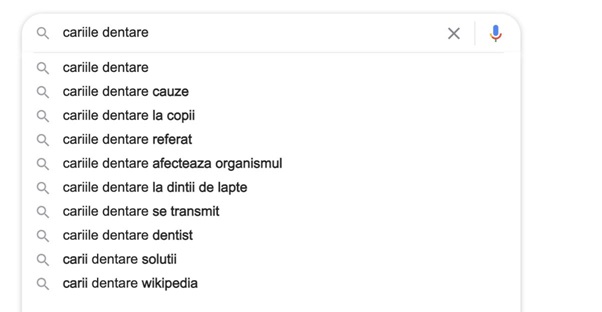
See what your customer is looking for online. Use google suggestions to find out what you search for most often.
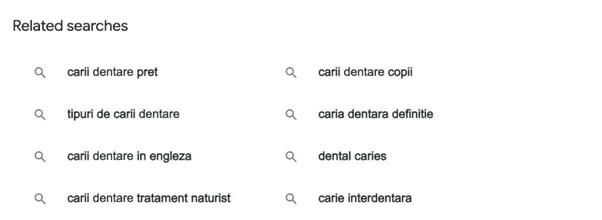
Don’t forget to look at similar searches at the bottom of the results page.
And now that you have an idea of what you want to write, start structuring the idea, from the simplest information to the most complex.
And, if it still seems complicated to you, I introduce you to my friend AIDA, whom I discovered and I think is wonderful.
A.I.D.A
A.I.D.A. is a formula that helps us write impactful texts, whether we are talking about articles on the site, social media posts or any other type of text.
A.I.D.A is an English acronym used to help you write a text that attracts and convinces readers.
It is not a super complicated technique, but a simple one, used for over 100 years to write impactful texts. These are a few steps you need to follow for your text to catch on every time.
Let’s meet AIDA
A – Attention
Use the title or first part of the text to get the reader’s attention and capture their attention. The title should be 6-10 words, as most people read only the title’s first and last 3 words. With a 6-word title, you have a good chance that the title will be read in its entirety by the visitor.
If you also have SEO in mind when writing the title, it should be between 50-60 characters. Some examples of headlines: Do you want healthy teeth for your baby? Foods that prevent cavities or Is sugar dangerous for teeth?
I – Interest
Write something that is interesting or unique or out of the ordinary, specific to a certain condition or service you offer. Interesting, unique or out of the ordinary must be features that the visitor of your site, who is not a specialist in the field of dentistry, has no way of knowing.
Even if it seems to you that the information you provide is an essential part of everyone’s health education, know that this does not apply to the vast majority of readers. And even if the visitor to your site knows them, it’s good to be reminded.
E.g: Can’t get your 2-3-year-old child to brush his teeth? Use food to keep your teethclean.
D – Desire
Explain in simple words why it is important to want the services you offer. Here the reader must be able to imagine, to be able to visualize the benefits of your dental services.
For example: Have you always been afraid of a milling cutter, a turbine and a visit to the dentist? Through the no-cut, no-pain services we offer, your fear will disappear as you say Aaaaa. The laser technology we use will surprise you and bring a smile back to your lips.
A – Action
At the end of the text, invite the reader to a simple action, for example, to contact you for an appointment or to distribute your article.
For example: Schedule a consultation today! Or Like & share this article if you found interesting information.
Now that you know A.I.D.A. make friends with her and follow the simple steps for your articles. Follow us in the next issue of the magazine to find out other techniques (Did you see what we did there?)
For any other information about web development and SEO solutions, you can find me online.
